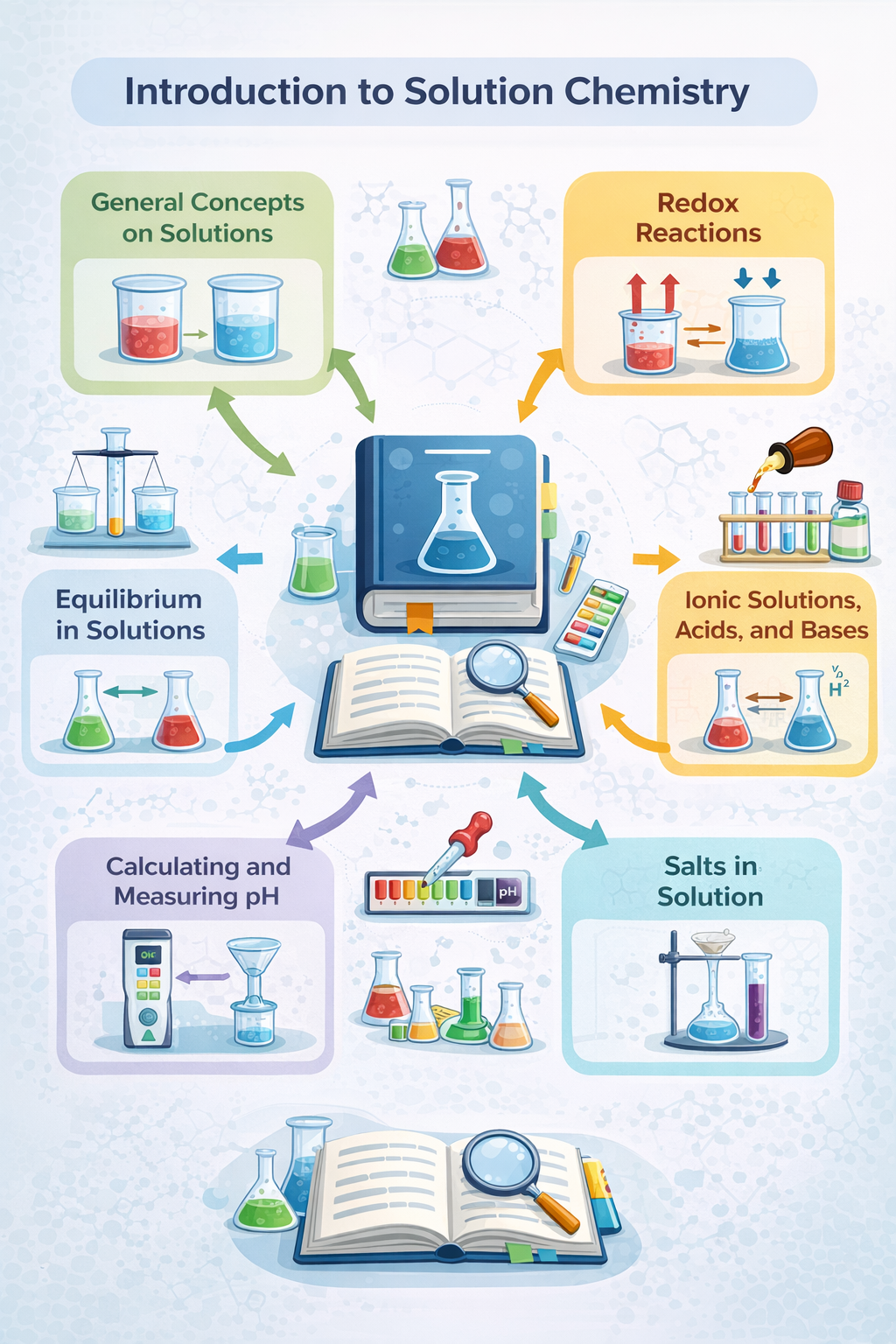
This Analytical Chemistry course introduces the fundamental principles governing chemical solutions and reactions in aqueous media. It begins with the study of mixtures, solutions, concentration units, and solubility. The course then develops the concepts of chemical equilibrium, including the equilibrium constant (K), reaction quotient (Q), and Le Châtelier’s principle. Redox reactions are examined through oxidation numbers, oxidizing and reducing agents, and balancing methods in acidic and basic media. It also explores ionic dissociation, electrolyte strength, and the self-ionization of water. Acid–base theories (Arrhenius, Brønsted–Lowry, and Lewis) are presented alongside acidity and basicity constants (Ka, Kb). The concept and calculation of pH for strong and weak acids and bases are detailed. Methods of pH measurement, including electrochemical and colorimetric techniques, are introduced. Finally, the course studies slightly soluble salts, solubility products (Ksp), and factors affecting solubility such as temperature, common-ion effect, and pH.
- معلم: BOURAS Hadj daoud
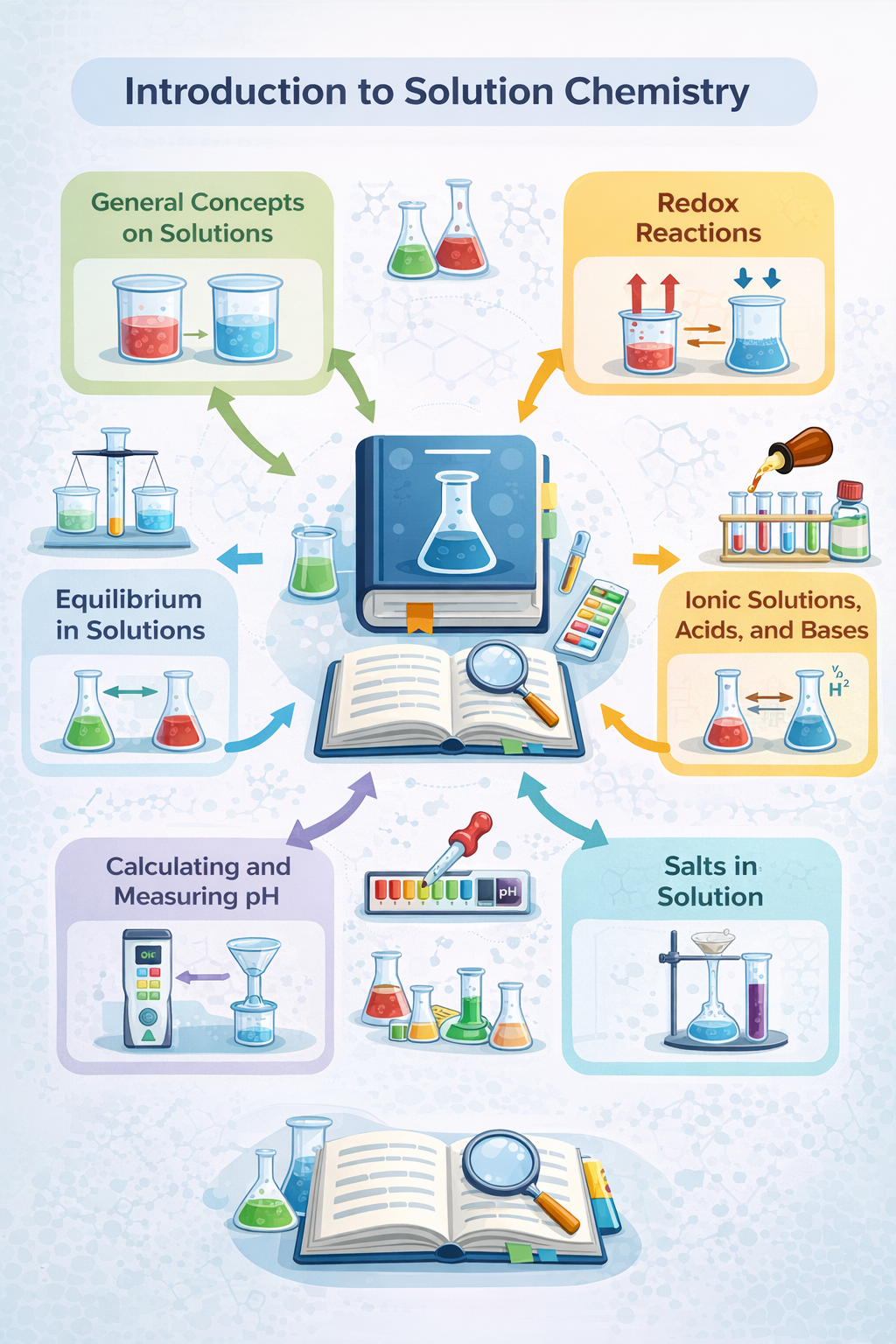
This course provides a comprehensive introduction to analytical and general chemistry concepts essential for understanding chemical systems in solution. It begins with fundamental notions of solutions, concentrations, and solubility, followed by a detailed study of chemical equilibrium and the factors influencing it. The course explores redox reactions, emphasizing oxidation–reduction processes, oxidizing and reducing agents, and reaction balancing. Ionic solutions are examined through dissociation equilibria, conductivity, and ionic strength. Special attention is given to acids and bases, including their definitions, strengths, and equilibrium constants. The concept of pH is developed with methods for calculation and measurement. Acid–base reactions and neutralization processes are analyzed in different systems. Finally, the course addresses salts in solution, solubility products, and equilibrium shifts. Overall, the course builds a solid theoretical foundation for chemical analysis and problem-solving in solution chemistry.
This course offers a foundational understanding of chemical solutions and their behavior. It begins with the definition of a solution and various expressions of concentration. The course then explores chemical equilibrium, covering both homogeneous and heterogeneous systems, the equilibrium constant, factors that influence equilibrium, and Le Chatelier’s Principle. Redox reactions are introduced through the concepts of oxidation and reduction, oxidation numbers, and the balancing of redox equations. The study continues with ionic solutions, emphasizing ionic dissociation, the self-ionization of water, and the Brønsted definitions of acids and bases, including their relative strengths. The concept of pH is then addressed, including how to calculate and measure it, as well as the neutralization process. The course concludes with the behavior of salts in solution, focusing on slightly soluble salts, solubility, and the solubility product, along with how equilibrium shifts affect solubility.
- معلم: BOURAS Hadj daoud